
Why India's Narendra Modi chose to back Israel over Iran

Why did India's Narendra Modi travel to Israel two days before the US and Israel launched a war on Iran?
That's the question Indians have been trying to answer over the last several days.
The war in Iran, which has claimed 1,000 lives in Iran and wreaked havoc across the entire Gulf over the past seven days, already looks set to be one of the most consequential wars in the Middle East for a generation.
Iran is the long-suffering final outpost against Israeli expansion and domination of the region.
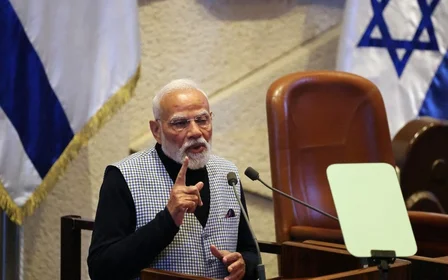
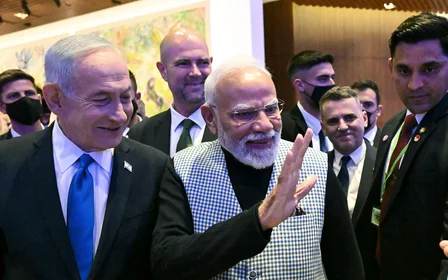
So, when Modi embraced Netanyahu, upgraded ties to Special Strategic Partnership for Peace, Innovation and Prosperity, and walked off with his newly-invented Knesset medal for his service to the Israeli people, had he been briefed about the coming assault?
New MEE newsletter: Jerusalem Dispatch
Sign up to get the latest insights and analysis on Israel-Palestine, alongside Turkey Unpacked and other MEE newsletters
In the days since the killing of Iranian Supreme Leader Ayatollah Ali Khamenei, not only has the Indian government declined to condemn his assassination, but the Indian prime minister has yet to offer even the most pithy of condolences to the Iranian people.
Then, this week, an Iranian navy vessel returning from a visit to India was torpedoed by the US in international waters, killing dozens on board. The vessel was unarmed, having travelled for the International Fleet Review at India's invitation before the launch of the US-Israel war on Iran.
Former Indian military officers and diplomats described the incident as a “strategic embarrassment” to the Indian government and a “blow to its regional credibility”.
India's frigid response has caught the Indian liberal elite and the main opposition parties by surprise. Iran was not merely an acquaintance of India, after all. For decades, Iran has counted it among its closest allies.
Indians are wondering whether their country has squandered its purported "strategic autonomy" and is now a vassal state of the US.
But observers and intellectuals following India closely say that New Delhi’s support for the war on Iran is not as confounding as it first appears.
The Hindu Rashtra
Since Modi became prime minister in 2014, India has been inching towards a Hindu Rashtra, or a Hindu state.
Observers and scholars argue that with the judiciary, police and much of the media captured by the Rashtriya Swayamsevak Sangh - the Hindu paramilitary umbrella group under which the Bharatiya Janata Party operates - the transformation of the state into a Hindu Rashtra is close to complete.
During the Hindu festival of Holi earlier this week, Muslims in towns in Uttar Pradesh were told to cover mosques with polyester sheets to purportedly prevent Hindu mobs from damaging them.
The insinuation, however, couched in a language of protection, was clear: to survive in India, Muslims increasingly needed to render themselves invisible in public life.
“New Delhi increasingly frames its interests through a civilisational, 'anti‑terror' lens that maps neatly onto US and Israeli security discourses, especially under Modi,” Suchitra Vijayan, author of Midnight's Borders: A People's History of Modern India, told MEE.
Vijayan said Islamophobia had become entrenched in India's foreign policy, and its philosophy of non-alignment had effectively been replaced by a principle of strategic annihilation of Muslims.
"This is what guides India’s external alignments today," she added.
Indian officials have themselves conceded that Israel is not merely a trading partner or source of weapons but a model to emulate.
Delegations of Indian police, politicians and businessmen routinely travel to Israel to study Israeli governance, management of dissent and the commodification of its security model.
Israeli tactics are already present in India - be it in the suppression of farmer protests in Haryana, the use of Pegasus to surveil politicians in Delhi, or the demolition of homes of dissidents in Indian-controlled Kashmir.
Indian universities are collaborating with their Israeli counterparts and assisting in the development of weapons for both the Indian and the Israeli state.
"India's support for Israel on Iran is not an aberration," Vijayan added.
The genocide in Gaza
India's position on Iran has to be seen through the prism of New Delhi's role in Gaza.
Over the past two and a half years, in which more than 200,000 Palestinians have been killed or injured, multiple reports have shown that India has sent arms, including combat drones, and Indian labour to replace Palestinian workers. New Delhi has also consistently provided diplomatic cover for Israel at the United Nations.
India did not immediately accept the Gaza ceasefire resolution and refused to endorse an arms embargo, saying that it would be guided by its national interest before reconsidering its weapons deals with Israel.
"Where Israel is concerned, it is a country with which we have a strong record of cooperation in national security. It is also a country that has stood by us at different moments when our national security was under threat," India's external affairs minister, Subrahmanyam Jaishankar, said at the time.
The Indian state's complicity in the genocide in Gaza also extends to several Indian companies that remain deeply embedded in Israel's military-industrial complex as buyers and co-producers.
It has also extended to the street, where the state has stymied protests or pro-Palestine advocacy, both in public spaces and on university campuses.
The Indian government has also refused to join South Africa's genocide case against Israel at the International Court of Justice, and India’s opposition has not pressured it to do so either.
As a consequence, the Indian state’s endorsement of Israel’s genocide in Gaza filtered into everyday state violence, making it abundantly clear that the genocide in Gaza would carry no political consequences for the governing party.
During India's war with Pakistan in mid-2025, several commentators in India and even diaspora-based Hindu nationalist groups called for the flattening of Kashmir "like Gaza".
"This is only a continuation of this growing camaraderie between the two countries that has led to India's particular stance in this war on Iran," Somdeep Sen, a research associate at the Center for Asian Studies in Africa at the University of Pretoria, told MEE.
Economic opportunities
The war on Iran and in the Gulf is already driving up oil and gas prices, and India would almost certainly bear the brunt.
Iran has halted the movement of vessels in the Strait of Hormuz, and India is said to have barely a month’s worth of emergency energy supplies.
With around nine million Indians employed across the Gulf - particularly in the UAE, Qatar, Saudi Arabia, and Kuwait - sending billions of dollars in remittances back home, a prolonged war would not only drive oil prices higher but could also severely disrupt migrant livelihoods and the sectors of India’s economy that depend heavily on the inflows.
"Its diaspora in the Gulf faces an uncertain future, with evacuation impossible due to airspace restrictions and the sheer scale of the population spread across multiple countries," Bhim Bhurtel, from Nepal Open University, wrote in The Asia Times.
"Its energy supplies are vulnerable. Its connectivity projects are at risk. And its voice carries no weight because everyone knows which side it is on," Bhurtel added.
It seems, however, that New Delhi has hedged its bets - quietly positioning itself for the economic opportunities that could arise if Iran were reintegrated into the global economy under a new political order.
As if on cue, on Friday the US government gave India a 30-day waiver to purchase Russian oil.
Meanwhile, there are indications that India has been gradually positioning itself more firmly within the US sphere of influence.
In 2025, India distanced itself from a Shanghai Cooperation Organisation statement that addressed Israeli strikes on Iran. It later signed the Tianjin Declaration, which condemned the strikes, but that was nearly three months after the incident.
More tellingly, earlier this year India stepped away from the Chabahar Port in Iran - a maritime gateway that bypasses Pakistan and connects India to Afghanistan - after facing American pressure.
At the time, The Sunday Guardian reported that "developments indicate not a retreat from Chabahar, but a strategic withdrawal from exposure [to sanctions from Trump]."
"Once geopolitical and sanctions conditions normalise, India’s posture at Chabahar is structured for rapid reactivation rather than reinvention," the paper noted.
Should the situation alter in Iran, India’s major conglomerates - owned by tycoons such as Adani, Ambani and Tata - already deeply embedded in infrastructure, logistics and defence partnerships with Israel, may find themselves well placed to capitalise on the economic opportunities that would follow.
The American-Israeli axis
Experts agree that Modi's calculus seems geared to joining the US-Israel axis in the Middle East, even at the expense of its long-held stance of "strategic autonomy".
The standoff with the US over India’s continued purchase of Russian oil, which resulted in tariffs of around 50 percent being imposed on India in August 2025, has ultimately seen New Delhi bow to US demands.
The submission appears so complete that India, which has long projected itself as a guarantor of security in the Indian Ocean region, reportedly stood by as the US torpedoed the naval vessel of a partner within its own neighbourhood.
A day before Modi arrived in Israel, Netanyahu announced the formation of what he called a "hexagon alliance", or a security and economic grouping that would "stand together against the radical axes".
The Israeli prime minister told his cabinet that the "hexagon of alliances" would include Israel, India, Greece and Cyprus, along with other unnamed Arab, African and Asian states.
He said the idea was to create an axis of nations that "see eye-to-eye on the reality, challenges, and goals against the radical axes, both the radical Shia axis, which we have struck very hard, and the emerging radical Sunni axis".
New Delhi is already part of the strategic partnership I2U2 (India, Israel, the UAE and the US) as well as the India-Middle East-Europe-Corridor that was set up in 2023 as a means to integrate Israel into the Middle East and launch a strategic alternative to the Belt and Road Initiative.
India is vital to its axis, as a labour supplier and manufacturing hub, as demonstrated by the upgrading of ties to a special strategic partnership with Israel in late February.
And though India's tilt towards Israel in its war on Iran has drawn outrage and criticism from opposition politicians, sections of the independent media and leftist activist groups, the absence of a strong political challenge to the government’s Hindu nationalist, domestic and foreign policy agenda suggests that little is likely to change in the foreseeable future.
Vijayan said that not only has India moved towards the US–Israeli axis, but she also said Israel was looking to work with regimes that were comfortable with its ongoing genocide and annihilation of the Palestinian people.
“There are very few countries where both the government and the vast number of people are not only anti‑Palestinian but openly anti‑Muslim. India is one of them,” she added.
Middle East Eye delivers independent and unrivalled coverage and analysis of the Middle East, North Africa and beyond. To learn more about republishing this content and the associated fees, please fill out this form. More about MEE can be found here.