
Renowned Palestinian historian Walid Khalidi dies aged 100

Renowned Palestinian historian Walid Khalidi has died aged 100 after a decades-long scholarship focused on the history and displacement of the Palestinian people.
The Institute for Palestine Studies (IPS) - a research and publication centre focused on the Palestinian plight that Khalidi co-founded in Beirut in 1963 - said he died in Cambridge, Massachusetts in the US on Sunday.
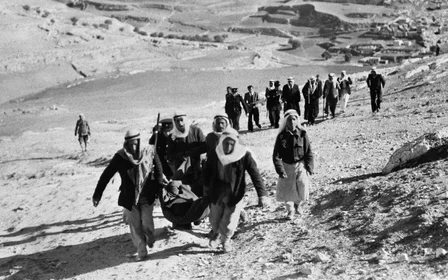
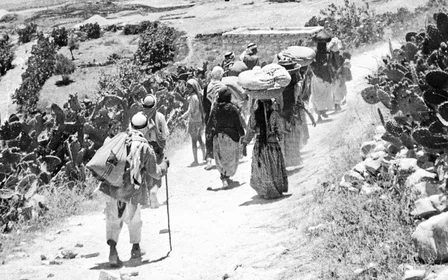
Khalidi was a leading figure in documenting Palestinian society before the Nakba - the “catastrophe” of 1948, when Zionist militias ethnically cleansed Palestinians from their homeland to pave the way for the creation of Israel.
Under his guidance, the institute produced significant studies, including translations between Hebrew, Arabic and English, and it remains a major resource on Palestinian history.
Known as “the historian of the Palestinian cause”, Khalidi’s scholarship included translations of Israel’s first Prime Minister David Ben-Gurion’s diaries and those of Moshe Sharett, a former Israeli prime minister and minister of foreign affairs.
New MEE newsletter: Jerusalem Dispatch
Sign up to get the latest insights and analysis on Israel-Palestine, alongside Turkey Unpacked and other MEE newsletters
The IPS also published The History of the Haganah, a detailed examination of Zionist militias involved in the ethnic cleansing of Palestinians during the Nakba.
Khalidi’s work revealed much previously hidden about the takeover and expulsion of Palestinians, including Plan Dalet, the 1948 master plan that guided the occupation of Palestinian land.
_-_arab_people_fleeing.pngae00.webp?itok=A3XNkgup)
His encyclopedic collections, including photographs and village records, provide rare insights into pre-1948 Palestine. Notable works include Before Their Diaspora: A Photographic History of the Palestinians and All That Remains: The Palestinian Villages Occupied and Depopulated by Israel in 1948.
Born in July 1925 to a family of academics in Jerusalem, Khalidi also had a distinguished academic career. He taught at Oxford until 1956, leaving in protest over the British-French-Israeli Suez intervention, and later served as a professor at the American University of Beirut until 1982. He subsequently became a research fellow at Harvard’s Center for International Affairs.
Throughout his life, Khalidi combined scholarship with political engagement. He had ties with the Arab Nationalist Movement, the Popular Front for the Liberation of Palestine and the Palestinian National Liberation Movement. He represented Palestine in the Arab League delegation in 1983 and in the joint Palestinian-Jordanian delegation to the Middle East peace talks in Washington, DC in 1991.
A proponent of a two-state solution, Khalidi described it in Foreign Affairs in 1988 as “the only conceptual candidate for a historical compromise of this century-old conflict”.
Middle East Eye delivers independent and unrivalled coverage and analysis of the Middle East, North Africa and beyond. To learn more about republishing this content and the associated fees, please fill out this form. More about MEE can be found here.